 Medical Training AI
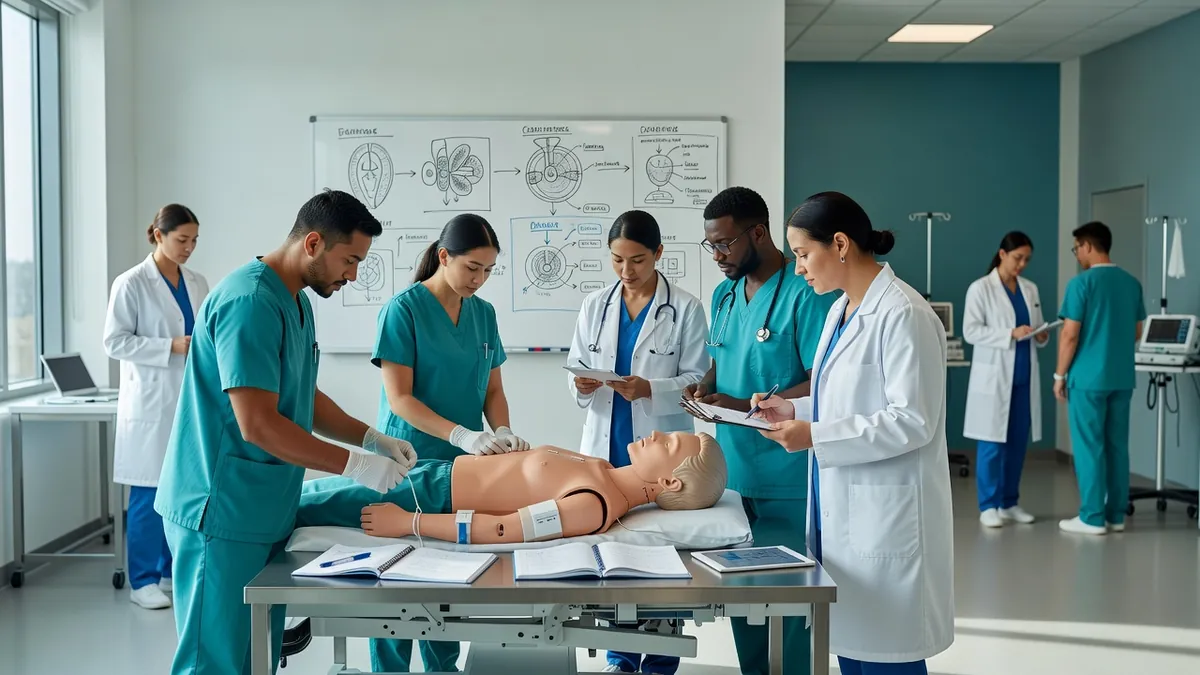
Learning Without Risk to Real Patients
Simulation-based medical education has transformed how healthcare professionals develop clinical skills. By replicating clinical scenarios in controlled environments, simulation allows learners to practice procedures, make decisions, and learn from mistakes without putting patients at risk.
From basic task trainers to sophisticated virtual reality environments, simulation technology offers unprecedented opportunities for deliberate practice and skill development.
The Rationale for Simulation
Traditional medical training relied on the apprenticeship model: learners observed procedures, then gradually assumed responsibility under supervision. While effective, this approach meant that patients became teaching subjects, and learners inevitably made errors during their development.
Simulation addresses this ethical tension by providing realistic practice environments where errors are learning opportunities rather than patient harms. Learners can repeat procedures until mastery, explore the consequences of different decisions, and build confidence before encountering real clinical situations.
Types of Simulation
Medical simulation encompasses diverse technologies and approaches. Task trainers focus on specific procedural skills, from venipuncture to suturing to airway management. These devices range from simple models to sophisticated systems with realistic tissue properties and feedback mechanisms.
High-fidelity mannequins simulate entire patients, complete with programmable vital signs, responsive pupils, audible heart and lung sounds, and the ability to deteriorate or improve based on interventions. These mannequins enable realistic team training for complex scenarios like cardiac arrest or trauma resuscitation.
Simulation Modalities in Medical Education
- Task trainers and part-task simulators
- High-fidelity patient simulators
- Standardized patients (actors)
- Virtual reality environments
- Augmented reality overlays
- Computer-based simulations
Standardized Patients
Trained actors portraying patients offer unique educational value. Standardized patients can present consistent clinical scenarios, demonstrate emotional responses, and provide feedback from the patient perspective. They are particularly valuable for teaching communication skills, history-taking, and sensitive examination techniques.
Hybrid simulations combine standardized patients with task trainers, creating scenarios where learners must both communicate effectively and perform procedures correctly.
Virtual and Augmented Reality
Emerging technologies are expanding simulation possibilities. Virtual reality immerses learners in three-dimensional environments where they can practice procedures, navigate anatomical structures, and experience rare scenarios. Augmented reality overlays digital information onto physical environments, guiding procedures and enhancing understanding.
These technologies are particularly valuable for procedural training, allowing learners to develop spatial awareness and hand-eye coordination in risk-free virtual environments.
The Power of Debriefing
Research consistently shows that the learning value of simulation depends heavily on debriefing. Simply experiencing a simulation produces limited learning; the structured reflection afterward is where deep learning occurs.
Effective debriefing helps learners analyze their performance, understand the reasoning behind their decisions, and identify opportunities for improvement. Skilled debriefers guide reflection without judgment, creating psychological safety that enables honest examination of performance.
"In simulation, making mistakes is not just acceptable, it is essential. The simulation center should be the safest place to fail, where every error becomes a lesson learned before facing real patients."
Evidence for Effectiveness
Decades of research support simulation effectiveness. Studies demonstrate that simulation-trained learners perform better on clinical assessments, make fewer errors, and develop competence more efficiently than those trained through observation alone.
Perhaps most importantly, some research shows that simulation training improves actual patient outcomes. Central line insertion training in simulation has been associated with reduced bloodstream infections. Laparoscopic simulation training improves operating room performance.
Integration with Clinical Training
Simulation works best when integrated thoughtfully with clinical experience. Pre-procedural simulation ensures learners have baseline competence before touching patients. Just-in-time simulation refreshes skills before uncommon procedures. Post-event simulation allows teams to practice responses to adverse events.
The goal is not to replace clinical experience but to ensure that clinical experiences are safer and more educational because learners arrive better prepared.
Practice with Simulation
Our training programs incorporate simulation exercises that let you develop skills in a supportive environment before applying them clinically.
Explore Training Options