 Medical Training AI
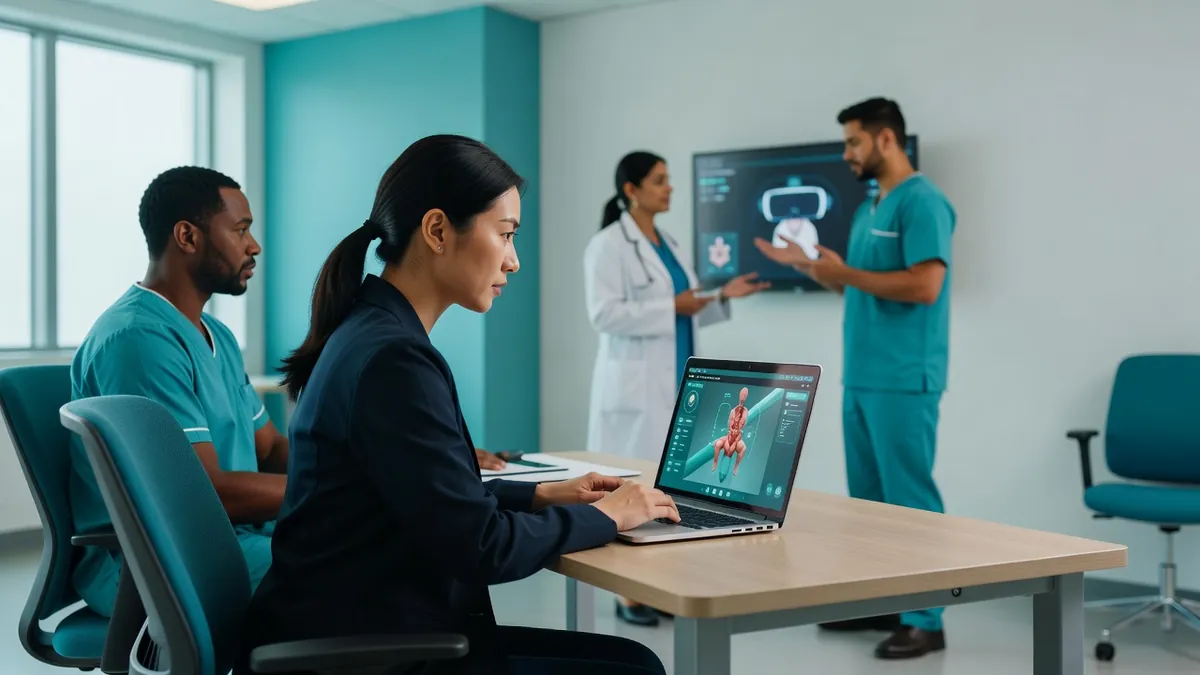
Immersive Training for Procedural Excellence
Virtual reality has evolved from science fiction to practical medical education tool. Today's VR systems offer training experiences that rival real clinical environments in complexity and educational value while eliminating patient risk during the learning process.
The promise of VR in medical education lies in its ability to create presence, the psychological sense of actually being in the virtual environment. This presence engages learners more deeply than screen-based learning, creates memorable experiences, and enables the development of spatial skills essential for procedural competence.
How VR Training Works
Modern VR procedural training typically involves a head-mounted display that creates immersive three-dimensional environments, combined with hand controllers or specialized instruments that track movement and provide haptic feedback. Learners see realistic anatomical structures, manipulate virtual tools, and experience the consequences of their actions in real-time.
The virtual environment can simulate any clinical setting: operating rooms, procedure suites, emergency departments, or examination rooms. Anatomical models recreate human structures with high fidelity, often derived from actual patient imaging. Tissue response to manipulation follows physics-based models that mirror real biological behavior.
VR Training Applications
- Surgical procedure rehearsal and practice
- Injection technique training
- Endoscopic and laparoscopic skill development
- Emergency response scenarios
- Anatomical exploration and learning
- Patient positioning and approach planning
Advantages Over Traditional Training
VR procedural training offers advantages impossible to achieve in traditional settings. Unlimited repetition allows learners to practice until proficient, without concern for patient availability or fatigue. Standardized scenarios ensure all learners encounter the same challenges, enabling fair assessment and comparison.
Rare complications and critical emergencies can be experienced repeatedly. In real clinical training, learners might never encounter certain scenarios. VR ensures exposure to the full range of situations they must be prepared to manage. This deliberate practice of low-frequency, high-stakes events builds the readiness that protects future patients.
Immediate feedback accelerates learning. VR systems track performance metrics throughout procedures: hand steadiness, movement efficiency, time to completion, anatomical awareness. This data provides objective assessment and identifies specific areas for improvement that would be difficult to perceive through observation alone.
Haptic Feedback and Tactile Realism
Advanced VR systems incorporate haptic feedback that creates tactile sensations corresponding to virtual interactions. Learners feel resistance when passing needles through tissue layers, the give when entering a body cavity, or the texture of different anatomical structures. This sensory information is crucial for developing the touch sensitivity expert practitioners rely upon.
Haptic technology continues to improve rapidly. Current systems approximate rather than perfectly replicate real tactile sensations, but the gap narrows with each generation. Even imperfect haptic feedback provides valuable training compared to learning without any tactile information.
Procedure Rehearsal and Planning
Beyond general skill building, VR enables rehearsal of specific procedures on patient-specific anatomy. Using imaging data from actual patients, VR can create personalized anatomical models for surgical planning. Surgeons practice approaches, identify challenges, and optimize strategy before entering the operating room.
This rehearsal capability may ultimately improve patient outcomes by ensuring surgeons encounter no surprises during actual procedures. Mental preparation through virtual rehearsal builds confidence and reduces cognitive load during real operations.
Current Limitations
Honest assessment of VR training must acknowledge current limitations. Equipment costs remain significant, though declining. Visual resolution, while impressive, does not yet match human visual acuity. Haptic feedback approximates but does not perfectly replicate tactile sensations. Motion sickness affects some users, limiting session duration.
VR cannot replace all aspects of real clinical training. Team dynamics, patient communication, and working within actual clinical environments require real-world experience. VR builds component skills that must be integrated during supervised practice with actual patients.
Integration with Curriculum
Effective VR training integration requires thoughtful curriculum design. VR sessions should have clear learning objectives aligned with overall competency goals. Preparatory activities ensure learners arrive ready to engage productively. Debriefing following VR practice helps learners extract lessons and plan for improvement.
Assessment in VR should connect to broader evaluation frameworks. Skills demonstrated in virtual environments must be verified during actual clinical practice. VR performance data becomes one input among several in comprehensive competency assessment.
"The first time I performed the procedure on a real patient, it felt familiar rather than terrifying. The VR practice had given me confidence in my technique and prepared me for what I would see and feel."
The Future of VR Medical Training
Technological advancement will continue expanding VR training capabilities. Higher resolution displays will enable perception of finer anatomical details. Improved haptic devices will more accurately recreate tissue interactions. AI integration will enable adaptive scenarios that respond intelligently to learner actions and provide personalized feedback.
Accessibility will improve as costs decrease. What currently requires dedicated VR labs may eventually be possible with affordable consumer equipment. This democratization will extend immersive training benefits to learners and institutions previously unable to access such technology.
Experience VR-Enhanced Training
Our advanced training programs incorporate virtual reality for procedural skill development in a risk-free environment.
Explore VR Training