 Medical Training AI
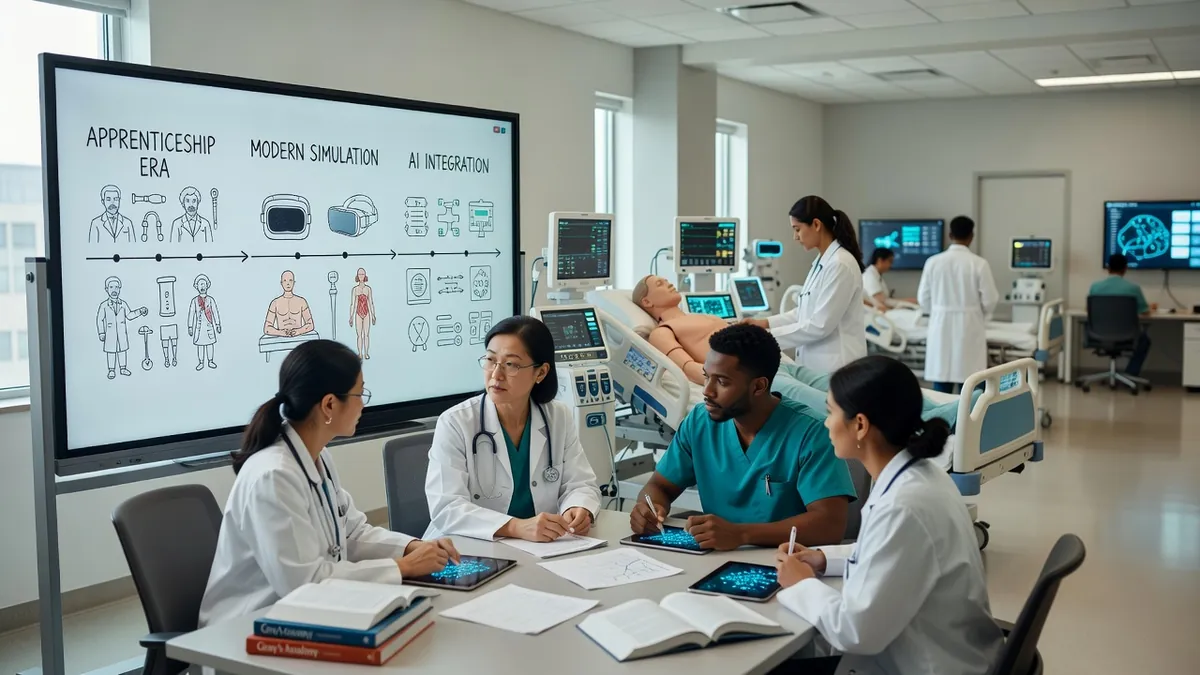
A Journey Through Centuries of Medical Training
The path to becoming a physician has transformed dramatically over millennia. From watching and learning at the bedside of a master healer to engaging with artificial intelligence tutors, medical education reflects the broader evolution of human knowledge and technology.
Understanding this history helps us appreciate current innovations and anticipate future developments in how we train the next generation of healthcare professionals.
The Era of Apprenticeship
For most of human history, medical knowledge passed from master to student through direct observation and hands-on practice. In ancient Greece, aspiring physicians studied under established healers, learning through demonstration and gradual assumption of patient care responsibilities.
This apprenticeship model persisted for centuries, with its inherent strengths and limitations. Students received individualized attention and practical experience, but the quality of education varied enormously depending on the master's knowledge and teaching ability. There was no standardization, no formal assessment, and no guarantee of competency.
The Birth of Formal Medical Schools
The establishment of universities in medieval Europe marked a significant shift. Medical schools in Salerno, Bologna, and Paris began offering structured curricula that combined theoretical instruction with clinical observation. For the first time, medical education had institutional oversight and established standards.
Yet even these early schools relied heavily on lectures and texts rather than practical experience. Students might graduate having never examined a living patient, their knowledge derived primarily from ancient authorities like Galen and Hippocrates.
Key Milestones in Medical Education History
- 1765: First American medical school founded at the University of Pennsylvania
- 1847: American Medical Association established, advocating for educational standards
- 1910: Flexner Report transforms medical education in North America
- 1960s: Problem-based learning introduced at McMaster University
- 1990s: Simulation centers begin appearing in medical schools
- 2020s: AI-powered adaptive learning platforms emerge
The Flexner Revolution
Perhaps no single document has shaped modern medical education more than Abraham Flexner's 1910 report. His scathing assessment of American and Canadian medical schools led to sweeping reforms: closure of substandard institutions, integration of basic sciences with clinical training, and establishment of teaching hospitals where students could learn through direct patient care.
The Flexner model emphasized scientific rigor and clinical experience. Medical education became longer, more expensive, and more demanding, but graduates emerged better prepared to practice medicine. This framework dominated for over a century and continues to influence medical training today.
Innovation in Teaching Methods
The late twentieth century brought new pedagogical approaches to medical education. Problem-based learning, pioneered at McMaster University in the 1960s, shifted focus from passive lecture attendance to active engagement with clinical scenarios. Students worked in small groups to analyze cases, identify learning needs, and discover knowledge through investigation.
Simulation technology offered another breakthrough. Mannequins that simulate vital signs, bleeding, and breathing allowed students to practice procedures and manage emergencies without risk to real patients. High-fidelity simulation centers became essential components of medical schools worldwide.
The Digital Transformation
The internet revolutionized access to medical knowledge. Online databases, virtual anatomy programs, and digital learning platforms supplemented traditional instruction. Students could review lectures at their own pace, access the latest research instantly, and connect with peers and mentors worldwide.
Mobile technology extended learning beyond the classroom. Applications for drug references, clinical calculators, and point-of-care guidelines became essential tools for students and practitioners alike.
The AI Era Arrives
Today, artificial intelligence is opening new frontiers in medical education. Adaptive learning systems analyze student performance to deliver personalized curricula that address individual weaknesses. Natural language processing enables intelligent tutoring systems that can answer questions, explain concepts, and guide clinical reasoning.
Virtual reality and AI combine to create immersive training environments where students can practice complex procedures with realistic feedback. Machine learning algorithms help assess clinical skills, providing objective evaluation that supplements human judgment.
"Each generation of physicians stands on the shoulders of those who came before, inheriting accumulated wisdom while pushing the boundaries of what medical education can achieve."
Looking Forward
The future of medical education will likely combine the best elements of every era: the personalized attention of apprenticeship, the structured curricula of formal schooling, the scientific rigor of the Flexner era, the active learning of modern pedagogy, and the technological sophistication of digital and AI-powered tools.
What remains constant is the fundamental goal: preparing competent, compassionate physicians who can provide excellent care for their patients. The methods evolve, but the mission endures.
Experience Modern Medical Education
Discover how Medical Training AI combines the best of traditional and innovative approaches to help you master aesthetic medicine.
Explore Our Courses